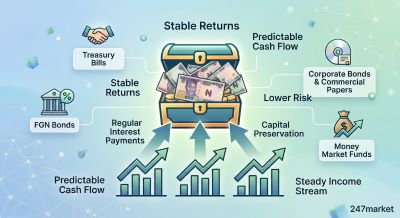
Treasury bills remain one of the most widely patronised money market instruments, appealing to both institutional and retail investors seeking relatively low-risk, short-term investment opportunities. Others include commercial paper, bankers' acceptances, repurchase agreements (Repos), and certificates of deposit.
Money market funds, a type of collective investment scheme that pools resources and invests in a collection of money market instruments, are also very popular choices among investments of all categories.
In this article, you will learn what Treasury Bills are and know how to invest in them.
What is a Treasury bill?
A Treasury Bill (T-Bill) is a short-term debt instrument issued by the government to raise funds, usually for periods of 91, 182, or 364 days, and sold at a discount to its face value. So when you invest in a Treasury Bill, you are effectively giving a short-term loan to the Federal Government. In return, the government promises to pay you back a fixed amount on a fixed date.
Three facts define a T-bill:
- It is short-term. It matures in one year or less.
- It is sold at a discount. You pay less than the face value and receive the full face value at maturity.
- It carries low credit risk. The borrower is the government, so T-bills are widely treated as one of the safest local-currency investments.
Key terms
| Term | Meaning |
|---|---|
| Face value | The amount the government pays you at maturity |
| Maturity date | The date you get the face value |
| Tenor | The length of the bill, from purchase to maturity |
| Discount | The gap between what you pay and the face value |
Why does the government issue Treasury bills?
Governments often need money before their tax revenue arrives. T-bills are a way to borrow it for a short time. The government also uses them to manage cash flow and to influence the amount of money circulating in the financial system.
For you as an investor, the arrangement is simple. The government needs money now, you have money to lend, and you agree on a return.
The three tenors
Nigerian T-bills are issued in three lengths:
| Tenor | Approximate duration | Best for |
|---|---|---|
| 91-day | 3 months | Short-term parking of cash |
| 182-day | 6 months | Mid-term goals |
| 364-day | 1 year | Locking in a rate for a full year |
Investor tip: Match the bill to when you will need the money. If you need it in six months, buy a bill that matures in about six months. Buying a longer bill and selling early exposes you to price risk.
How you earn money with Treasury Bills
A T-bill pays no periodic interest. You buy it for less than its face value, and that discount is your profit.
Worked example
Suppose you buy a one-year (364-day) bill with a face value of ₦1,000,000 at a discount rate of 10%.
- Price you pay: about ₦900,274
- Amount you receive at maturity: ₦1,000,000
- Your profit: about ₦99,726
(These numbers are illustrative.)
Notice that a 10% discount rate does not mean a 10% return on what you paid. You paid ₦900,274 and earned ₦99,726, which is about 11.1% on the money you invested. This is one of the most important ideas for a beginner, and this characteristics is explained in subsequent sections.
The simple formulas (for readers who like to check the math)
- Price = Face value × (1 − discount rate × days ÷ 365)
- True yield = Discount rate ÷ (1 − discount rate × days ÷ 365)
You do not need to calculate these yourself. Your bank or broker will show the price, but understanding the formula helps you see why the numbers behave as they do.
The primary market: how T-bill auctions work
The primary market is where new T-bills are sold for the first time. In Nigeria, the Central Bank of Nigeria (CBN) runs the auctions on behalf of the government. They are usually held at regular intervals, often every two weeks.
Here is the process, step by step.
Step 1: The offer is announced. The CBN publishes how much of each tenor is on offer. For example, ₦100 billion of 91-day bills, ₦100 billion of 182-day bills and ₦400 billion of 364-day bills.
Step 2: Investors submit bids. Banks, asset managers, companies and other institutions bid through authorised dealers. Each bid states the amount the investor wants to buy and the rate at which they are willing to buy.
Step 3: The government picks the winners. The bids are arranged from the lowest rate to the highest. The government accepts the cheapest bids first, because a lower rate means cheaper borrowing for it. It keeps going until it has raised the amount it wants, or until the remaining bids ask for more than it is willing to pay.
Step 4: The stop rate is set. The rate of the last accepted bid is called the stop rate.
Step 5: Winning investors pay and receive their bills.
A simple illustration
The government offers ₦100 billion of 364-day bills and receives these bids:
| Investor | Amount | Rate requested |
|---|---|---|
| A | ₦30bn | 14.50% |
| B | ₦40bn | 15.00% |
| C | ₦50bn | 16.00% |
Total bids are ₦120 billion for ₦100 billion of bills. A and B are accepted first. Only ₦30 billion of C's bid is needed to fill the offer, so C may be partly filled, or rejected if the government finds 16% too expensive. (Illustrative figures.)
Two numbers you will see in auction news
- Subscription: the total value of all bids. It is not the amount the government borrows.
- Bid-to-cover ratio: subscription ÷ amount offered. A ratio of 5× means investors bid five times the amount on offer. A high ratio signals strong demand, which often pushes rates down. A ratio below 1× means the auction was undersubscribed.
Stop rate vs yield: what is the difference?
Beginners mix these up more than anything else, so read this section carefully.
The stop rate is the cut-off rate at a specific auction, meaning the last bid the government accepted. It is a headline number that tells you where the market settled. It is the figure you will see in newspapers.
The yield is the actual return you earn, based on the price you paid, the face value you will receive and the time to maturity.
| Stop rate | Yield | |
|---|---|---|
| What it is | The cut-off rate at an auction | Your actual return on the price paid |
| Who sees it | Everyone (published after the auction) | You, on your own purchase |
| Applies to | The auction as a whole | Your specific bill |
| Changes after purchase? | No | It depends on whether you hold or sell |
Why they differ
- Discount rate vs true yield. Nigerian T-bill rates are usually quoted as discount rates. As the worked example showed, a 10% discount rate translates to a true yield of about 11.1%. The higher the rate and the longer the tenor, the wider the gap.
- Not everyone pays the stop rate. The stop rate is the marginal rate. Successful bids can be at different rates within a range, and the CBN publishes this range in its auction results.
- Intermediary margins. If you buy through a bank, broker or platform, your effective return may be lower than the auction rate because of dealer margins or fees.
Tip: Before you buy, ask for four numbers: price, face value, maturity date, and effective yield. Compare offers by yield, not by the headline rate.
The secondary market: buying and selling before maturity
The secondary market is where existing T-bills are traded between investors after the auction.
Why it exists: Suppose you buy a one-year bill and need your money after four months. You do not have to wait. You can sell the bill to another investor.
Why you might buy there:
- You can buy at any time, without waiting for the next auction.
- You can choose a bill with a specific remaining maturity, for example three months left.
How prices move
The price of a T-bill and its yield move in opposite directions.
- If market yields fall, existing bills become more valuable and their prices rise.
- If market yields rise, existing bills become less attractive and their prices fall.
Why? Imagine you hold a bill that will pay a good rate. If new bills are then issued at lower rates, yours looks better by comparison, so buyers will pay more for it. If new bills are issued at higher rates, buyers will pay less for yours.
Example: You buy a bill and later sell it before maturity.
- If yields have fallen, you may sell at a gain.
- If yields have risen, you may sell at a loss compared with simply holding to maturity.
The takeaway: If you hold a T-bill to maturity, you know exactly what you will get. If you sell early, the price depends on the market that day. Also note that the price offered to retail sellers may include the dealer's margin.
Who can invest, and how?
1. Commercial banks. Many banks sell T-bills to customers. This is the most familiar route. Ask about minimum amounts and the rate you will actually receive.
2. Stockbrokers and investment firms. Licensed brokers and asset managers buy T-bills for clients, in both the primary and secondary markets.
3. Fintech and investment apps. Several licensed platforms let you buy T-bills from your phone with smaller amounts. Always confirm the platform is licensed and find out who the underlying dealer or custodian is.
4. Money market and fixed-income funds. Instead of buying a bill directly, you buy units in a fund that invests in T-bills and other short-term instruments. This is convenient for small amounts and gives you diversification, but the return is not fixed and is reduced by the fund's fees.
Direct T-bills vs. T-bill funds
| Direct T-bill | Money market fund | |
|---|---|---|
| Return | Known at purchase (if held to maturity) | Varies |
| Fees | Dealer margin | Management fees |
| Minimum | Depends on the intermediary | Often lower |
| Access to money | At maturity, or sell in the secondary market | Usually easier to redeem |
Step-by-step: how to make your first Treasury bill investment
Step 1: Define your goal and timeline. Ask yourself: What is this money for? When will I need it? An emergency fund, a rent payment next year, and a long-term savings pot call for different choices.
Step 2: Choose your tenor. Match it to your timeline. Money needed in about three months suits a 91-day bill. Money you can leave for a year suits a 364-day bill.
Step 3: Choose a licensed channel. Use a bank, an SEC-registered broker or a licensed investment platform. Do not hand money to anyone promising "guaranteed T-bill returns" outside a regulated institution.
Step 4: Complete your KYC. Expect to provide your BVN, a valid ID and basic personal details.
Step 5: Ask the four key questions.
- What is the price I will pay?
- What is the face value I will receive?
- What is the maturity date?
- What is my effective yield after all charges?
Step 6: Fund your account and place your order. Say whether you want to buy at the next auction (primary) or now (secondary), the amount, and the tenor.
Step 7: Check your confirmation. It should state the face value, purchase price, yield, tenor, and maturity date. Keep it safe.
Step 8: Decide what happens at maturity before it arrives. Will you withdraw, roll over into a new bill, or move the money into another investment? Most intermediaries let you set this instruction in advance.
Step 9: Review and repeat. After your first investment, you will understand the process. You can then scale up, mix tenors or explore other fixed-income instruments.
Before you commit, compare: minimum investment, fees or margins, your actual yield, early-exit terms, and how and when proceeds are paid.
Five ways to make money with Treasury bills
1. Hold to maturity. Buy at a discount and collect the face value. It is simple, predictable, and the return is known when you buy.
2. Roll over. When a bill matures, buy another. This keeps your money working continuously. The risk is that rates may have fallen when you reinvest.
3. Lock in a rate. If you believe rates will fall, buying a longer-tenor bill fixes today's rate for longer. If you are wrong and rates rise, you will have locked in a lower rate than the market later offers.
4. Ladder your bills. Split your money across different tenors. For example, buy a 91-day, a 182-day and a 364-day bill. As each matures, you get cash access at regular intervals and can reinvest at the current rate. This balances flexibility with yield.
5. Trade in the secondary market. Buy when you expect yields to fall, and sell after prices rise. This is more advanced and involves price risk, so beginners should get comfortable with holding to maturity first.
Risks every beginner should understand
T-bills are low-risk, not no-risk.
- Inflation risk. If inflation is higher than your yield, your money buys less at maturity even though the naira amount has grown.
- Reinvestment risk. When your bill matures, rates may be lower than when you started.
- Interest rate (price) risk. Selling before maturity when yields have risen can produce a loss.
- Liquidity risk. Selling early depends on finding a buyer at a fair price.
- Intermediary risk. Your money passes through banks, brokers, or platforms. Use only licensed and regulated ones.
- Cost and tax. Dealer margins, fees, and any taxes affect your net return. T-bill income has historically enjoyed favourable tax treatment in Nigeria, but rules can change, so confirm the current position with your intermediary or a tax adviser.
What moves T-bill rates?
Rates are not random. They respond to:
- The CBN's policy rate (MPR) and expectations about where it is heading.
- Liquidity in the banking system. More cash chasing limited bills pushes rates down.
- Inflation expectations. Investors want a return that compensates for rising prices.
- The government's borrowing needs. More bills on offer can push rates up.
- Demand at each auction. Strong demand, shown by a high bid-to-cover ratio, usually pushes the stop rate lower.
Why high demand can accompany falling rates:
When many investors compete for a limited supply of bills, some accept lower returns just to get an allocation. Others buy because they expect rates to fall further and want to lock in today's rate. So heavy demand and falling rates often happen at the same time.
Note also that T-bill rates and the MPR are related but do not move one-for-one. A policy rate change shifts expectations, and the auctions then reveal how the market prices them.
Is a Treasury bill right for you?
T-bills suit you if you:
- want a predictable return over a known period
- value low credit risk
- want somewhere to park money for a defined time
- are new to investing and want a simple starting point
T-bills may not suit you if you:
- need instant, penalty-free access to all your money at any moment
- are aiming for returns well above inflation over many years, where other assets may serve better
- are uncomfortable with the fact that rates change over time
Many investors use T-bills as one part of a broader plan: an emergency fund, a savings goal with a fixed date, or a holding place while waiting for other opportunities.
Frequently asked questions
What is a Treasury bill in simple terms?
It is a short-term loan to the Federal Government. You buy it at a discount and get the full face value at maturity.
How often are Treasury bill auctions held in Nigeria?
Usually every two weeks, though the CBN publishes the calendar, so check for current details.
What is the minimum amount to invest in Treasury bills?
N50 million in the primary market. However, your intermediary may provide a channel that allows you buy indirectly with a smaller amount. In this regard, banks, brokers, and platforms set their own minimums, and the primary auction itself is aimed at large institutional bidders, which is why retail investors buy through intermediaries.
What is the difference between a stop rate and a yield?
The stop rate is the cut-off rate at an auction. Your yield is the return you actually earn on the price you paid. The two are related but not identical.
Can I lose money on a Treasury bill?
If you hold to maturity, you receive the full face value, so your naira return is known in advance. You can lose money in real terms if inflation exceeds your yield, and you can lose money in the secondary market if you sell after yields have risen.
Can I sell before maturity?
Yes, through the secondary market, but the price depends on market conditions and may include a dealer margin.
What is the difference between a T-bill and an FGN bond?
A T-bill is short-term (one year or less) and sold at a discount. An FGN bond is longer-term and typically pays periodic interest (coupons).
Are T-bills taxed?
Government securities have historically been treated favourably for tax purposes in Nigeria, but rules can change. Confirm with your intermediary or a tax adviser.
Are T-bills better than a fixed deposit?
It depends on the rates, fees, tenor and flexibility on offer. Compare the effective yield, not just the headline rate.
Final thoughts
A Treasury bill is one of the easiest investments to understand once the jargon is out of the way. The government borrows from you, you receive a discount up front in effect, and you collect the full amount on a known date. The details that matter are which tenor to choose, the difference between the stop rate and your yield, and the trade-off between holding to maturity and selling early.
Start with a small amount, pick a tenor that matches your timeline, and use a licensed intermediary. Once you have seen one bill through from purchase to maturity, you will understand the instrument far better than any article can teach you.
This article is for educational purposes only and is not investment advice. Rates, fees, minimums and tax rules change, so verify current details with the CBN and your licensed intermediary before investing.